

Warsh’s Hawkish Tone Reshapes Bund Yield Outlook
On Monday, 31 August 2026, German government bond yields climbed to multi-year highs after Federal Reserve Governor Kevin Warsh delivered a hawkish speech that reverberated across European fixed-income markets. The 10-year Bund yield jumped 12 basis points to 2.85%, its highest level since 2011, while the 2-year Schatz yield rose 8 basis points to 2.40%.
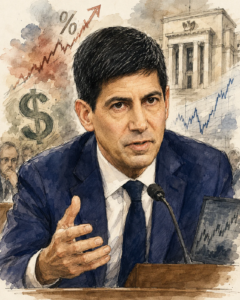
Warsh, speaking at an economic symposium in Jackson Hole, argued that central banks must prioritise inflation fighting over growth support, signalling that the European Central Bank (ECB) may need to accelerate its monetary tightening cycle. His comments were seen as a direct challenge to the ECB’s current gradualist approach, prompting traders to price in a more aggressive path for euro-area interest rates.
Bund Yield Spike Reflects Repricing of ECB Rate Path
The yield surge was driven by a repricing of ECB policy expectations. According to money market futures, the probability of a 50-basis-point hike at the ECB’s October meeting jumped from 30% to 55% following Warsh’s remarks. Markets now expect the deposit rate to peak at 3.25% by mid-2027, up from 2.75% previously.
This shift was amplified by thin liquidity conditions in August, as many European investors remain on summer holidays. Analysts noted that the move was more pronounced in longer-dated maturities, with the 30-year Bund yield rising 15 basis points to 2.95%, reflecting concerns that prolonged tight policy could weigh on long-term growth and inflation expectations.
Broader European Bond Market Feels the Pressure
The sell-off was not confined to Germany. French 10-year OAT yields rose 10 basis points to 3.20%, while Italian BTP yields climbed 14 basis points to 4.05%, widening the spread over Bunds to 120 basis points. This suggests that investors are demanding higher risk premia for peripheral euro-area debt, a sign of growing fragmentation risk.
In the UK, the 10-year Gilt yield also advanced 6 basis points to 4.10%, as global rate expectations tightened in tandem. The moves underline how interconnected global bond markets remain, with US monetary policy signals quickly transmitting to European fixed income.
Equities and Euro Respond to Rising Rate Expectations
European equities reacted negatively to the higher yield environment. The DAX fell 1.2% to 18,450 points, while the Euro Stoxx 50 dropped 1.0%. Rate-sensitive sectors such as real estate and utilities led the decline, as higher discount rates compress valuations. Meanwhile, the euro strengthened 0.4% against the dollar to $1.0850, supported by the prospect of tighter ECB policy.
“The market is realigning to a world where central banks are less willing to cushion growth,” said Lena Fischer, a rates strategist at Commerzbank. “Warsh’s comments have crystallised the risk that the ECB may be forced to follow a more hawkish path, which is a major shift from the dovish stance earlier this year.”
What Could Break the Yield Rally?
The key variable to watch is the euro-area inflation data due out on 3 September, which will either confirm or challenge the market’s hawkish repricing. If core inflation comes in below the 2.5% consensus, yields could retreat sharply as rate hike expectations unwind. Conversely, an upside surprise would likely push the Bund yield above the 2.90% level, a psychological threshold that could trigger further selling.
Additionally, the ECB’s September policy meeting on 17 September will be crucial. If the ECB delivers a hawkish surprise, such as signaling a faster taper of its bond-buying programme, the yield rally could extend. However, if the ECB pushes back against Warsh’s influence, the market may quickly reverse course. Traders should monitor these events closely, as the next 48 hours will likely set the tone for the remainder of the quarter.









Comments are closed.