

Warsh Holds 2% PCE Line as Inflation Risks Persist
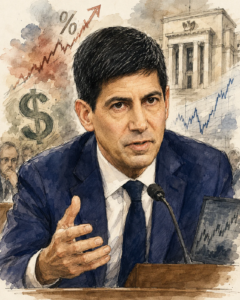
Federal Reserve Chair Kevin Warsh reaffirmed the central bank’s 2% PCE inflation target as “firm and fixed” during his Jackson Hole speech on Friday, August 28, 2026. Warsh warned that inflation is “not necessarily self-correcting,” signaling a continued hawkish stance despite recent market expectations for rate cuts.
“It’s the Fed’s job to deliver stable prices. No excuses,” Warsh said, according to a report from Coin Bureau. The remarks come as investors weigh the Fed’s next move against a backdrop of cooling but still-elevated inflation and resilient labor markets.
Warsh’s Hawkish Tone Caps Rate-Cut Hopes
Warsh’s language was notably more hawkish than that of his predecessor, Jerome Powell, who had emphasized data-dependence. By declaring the target “firm and fixed,” Warsh pushes back against any notion of a flexible inflation regime, which some market participants had speculated could emerge under his leadership.
The comments sent mixed signals across markets. The dollar index (DXY) edged higher in early trading, while U.S. Treasury yields rose modestly on the prospect of prolonged tighter policy. Meanwhile, crypto assets showed resilience, with Bitcoin (BTC) hovering near $58,000 and Ether (ETH) around $2,500, as traders weighed the implications for risk appetite.
Inflation Not Self-Correcting: Policy Implications
Warsh’s assertion that inflation is not self-correcting suggests the Fed will rely on active policy measures rather than waiting for supply-side healing. This stance could mean fewer rate cuts in 2026 than futures markets currently price. According to the CME FedWatch tool, traders see about a 60% chance of a quarter-point cut in September, but Warsh’s remarks may prompt re-pricing.
The PCE index, the Fed’s preferred inflation gauge, has cooled to 2.6% year-over-year as of June 2026, down from a peak of 7.1% in 2022. However, core PCE remains sticky at 2.8%, suggesting underlying pressures persist. Warsh’s comments imply the Fed will tolerate higher-for-longer rates to ensure a durable return to target.
Market Reaction: Stocks, Bonds, and Crypto
Equity futures trimmed gains after the speech, with the S&P 500 (SPX) dipping 0.2% in early trading. Bond markets reacted with a sell-off in short-dated Treasuries, pushing the 2-year yield up 4 basis points to 4.12%. Crypto markets showed less sensitivity, with Bitcoin and Ether trading flat to slightly higher, reflecting their growing decoupling from traditional macro drivers.
The key risk is whether Warsh’s hawkishness will spill over into risk assets. Historically, tighter Fed policy has weighed on high-valuation tech stocks and speculative assets, but the 2026 crypto market has been buoyed by institutional adoption and ETF inflows. A prolonged pause in rate cuts could test that resilience.
What to Watch: September FOMC and PCE Data
All eyes now turn to the September Federal Open Market Committee (FOMC) meeting, scheduled for September 15-16, 2026. The dot plot will be crucial—if it signals fewer cuts than the market expects, expect a sharp repricing. Also watch the August PCE report, due September 30, which will offer the latest read on inflation and could either validate or challenge Warsh’s caution.
For crypto traders, the correlation with the dollar and yields will matter. If the dollar strengthens on hawkish Fed expectations, Bitcoin could face headwinds. Conversely, if Warsh’s comments are seen as a one-off, risk assets may resume their upward trend. The next move in the 10-year Treasury yield, currently at 3.95%, will be a key signal for all markets.




Comments are closed.