
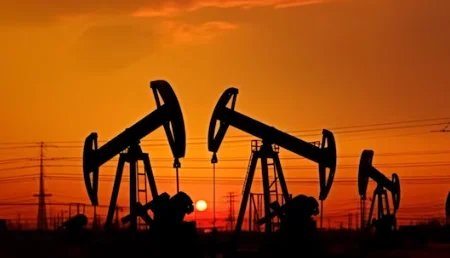
- WTI crude surged 2.47% to $85.46/barrel in early Asian trade, while Brent climbed 2.71% to $90.49/barrel.
- The escalation began Sunday when U.S. forces struck two Iranian rocket launchers on Larak Island in the Strait of Hormuz.
- Iran retaliated with strikes against U.S. bases in Jordan, marking the first direct exchange in over a month.
- Strait of Hormuz chokepoint risk is elevated, with roughly 20% of global oil consumption transiting the waterway.
- Energy equities and oil-linked ETFs are gaining as geopolitical risk premia reprice into futures curves.
Direct Military Exchange Resumes After Month-Long Lull
Oil futures opened the trading week with sharp gains as the United States and Iran resumed direct military exchanges, breaking a roughly month-long period of relative restraint. The latest escalation unfolded on Sunday when U.S. forces struck two Iranian rocket launchers positioned on Larak Island, a facility located inside the strategic Strait of Hormuz. According to a U.S. Central Command spokesperson, the attack was a defensive measure aimed at neutralizing a direct threat to maritime shipping lanes. The strike marks the first U.S. action against Iranian military assets since a previous round of tit-for-tat exchanges concluded over a month ago. Iran’s response came swiftly, with retaliatory strikes targeting U.S. bases in Jordan. The exchange has reignited concerns that the conflict could spiral into a broader regional war, potentially disrupting the free flow of crude from the world’s most important oil artery. The Strait of Hormuz, which connects the Persian Gulf with the Gulf of Oman, handles an estimated 20% of global petroleum consumption, making any threat to its navigability a systemic risk for energy markets.
Futures Reprice Geopolitical Risk Premium
At the time of writing, WTI front-month futures were trading at $85.46 per barrel, up 2.47% on the session, while Brent front-month futures had climbed 2.71% to $90.49 per barrel. The move represents a significant re-rating of the geopolitical risk premium that had been gradually unwound during the recent lull in hostilities. Traders are now pricing in a higher probability of supply disruptions, particularly if Iran were to escalate further by harassing or seizing commercial tankers transiting the strait. The market reaction extends beyond the crude complex. Energy equities are broadly higher, with major oil producers and oilfield services companies benefiting from the surge in underlying commodity prices. Exchange-traded funds tracking crude oil, such as the United States Oil Fund ($USO) and the ProShares Ultra Bloomberg Crude Oil fund ($BNO), are seeing elevated trading volumes as institutional and retail investors seek direct exposure to the price move. Integrated majors like Exxon Mobil ($XOM) are also gaining, as higher upstream revenues are expected to offset any potential refining margin compression.
Supply Side Remains Tight, Amplifying Price Response
The price reaction is amplified by an already tight global supply-demand balance. OPEC+ production cuts, combined with robust demand from Asia, have left the market with limited spare capacity to absorb any sudden loss of barrels. Analysts note that even a temporary disruption of just a few million barrels per day from the Gulf region could push prices into triple-digit territory, given the current inventory levels in OECD countries are below their five-year averages. The situation also carries implications for central bank policy. A sustained move above $90 per barrel in Brent would feed into headline inflation readings, potentially complicating the Federal Reserve’s path toward rate cuts. While the Fed has signaled a data-dependent approach, a renewed energy-driven inflation shock could delay easing expectations, which would in turn support the U.S. dollar and put additional pressure on emerging-market oil importers.
Diplomatic Channels Remain Open, But Risks Skew Higher
Despite the military escalation, diplomatic channels remain technically open. Back-channel communications through Omani and Qatari intermediaries have historically provided a circuit-breaker in past crises. However, the targeting of Larak Island, which hosts military infrastructure rather than civilian energy facilities, suggests a deliberate attempt by Washington to calibrate its response while avoiding a full-scale assault on Iran’s export capacity. Market participants are now closely watching for any signs of Iranian retaliation against civilian oil infrastructure, such as loading terminals or tankers. A strike on a major export facility would likely trigger a more violent price spike, potentially pushing Brent above the $95 level seen earlier this year. Conversely, a quick de-escalation could see the risk premium unwind just as rapidly, leaving futures vulnerable to a sharp correction. For now, volatility is expected to remain elevated, with options markets pricing in large daily swings across both crude benchmarks and energy equities.










Comments are closed.