
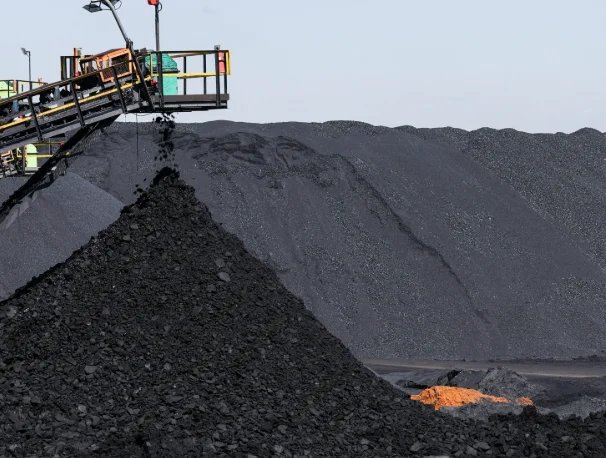
- China agreed to import at least 10 million metric tons of US coal next year and again in 2028, per the White House.
- The pledge emerged from a Trump-Xi summit that also extended tariff negotiations.
- The commitment is modest against China’s roughly 4.5-billion-ton annual coal consumption.
- US thermal and metallurgical coal producers are the most direct potential beneficiaries.
- Tariff talks continuing means the broader trade dispute remains unresolved.
The White House said China has agreed to import at least 10 million metric tons of coal from the United States next year and again in 2028, a commitment announced alongside a summit between President Donald Trump and Chinese President Xi Jinping that also extended tariff negotiations between the world’s two largest economies. The coal pledge is the most concrete commodity-specific element to emerge from the meeting, and it lands on a US coal industry that has been searching for export demand as domestic power generation continues its long transition away from coal-fired electricity.
For context, 10 million metric tons is a meaningful volume for US exporters but a rounding error for China, which consumes on the order of 4.5 billion metric tons of coal annually and produces the overwhelming majority of it domestically. The agreement is therefore best read as a political gesture — a deliverable that lets both sides claim progress — rather than a transformation of global coal trade flows. Even so, in a market where incremental demand is scarce, a committed multi-year buyer is not nothing.
Who Stands to Benefit
The most direct beneficiaries would be US coal producers with export-capable logistics. Peabody Energy ($BTU) operates some of the largest US thermal and metallurgical coal mines and has historically shipped through Gulf Coast and West Coast terminals. Arch Resources ($ARCH) is a major metallurgical coal exporter, and Alliance Resource Partners is a significant thermal coal producer with access to export markets. Consol Energy ($CEIX) operates the Pennsylvania Mining Complex and the Baltimore Marine Terminal, giving it direct seaborne export capability. Coal producers have generally benefited from strong seaborne thermal and met coal prices in recent years, and any incremental committed volume would support volumes and potentially pricing at the margin.
Railroads and terminal operators would also capture some benefit, since moving coal from mine to port is a meaningful part of the cost stack. The economics of the deal depend heavily on price. The White House did not disclose the price at which the coal would be sold, and coal is a globally traded commodity where Chinese buyers can source from Indonesia, Australia, Russia, and Mongolia, often at lower delivered cost than US-origin coal because of freight distances. If the agreement is executed at market prices, US producers gain volume; if it requires discounting, the margin benefit shrinks.
The Broader Trade Picture
The more consequential headline for markets is that tariff negotiations were extended rather than concluded. That means the underlying dispute — covering technology, industrial policy, agriculture, and market access — remains live. For equity investors, the coal commitment is a narrow, sector-specific positive, while the extension of talks preserves the broader uncertainty that has weighed on exporters, importers, and supply chains dependent on cross-border trade. Energy commodities broadly, including liquefied natural gas and agricultural goods, have been recurring bargaining chips in the US-China relationship, and coal now joins that list.
Investors should treat the 10-million-ton figure with appropriate caution. Government-to-government commodity commitments have historically been announced with fanfare and then under-delivered, either because commercial buyers balk at price or because logistics and port capacity constrain flows. The pledge covers next year and 2028, leaving a gap year in between, which itself suggests a political rather than a purely commercial construction. The practical takeaway is modest: a small, supportive demand signal for US coal exporters, a reminder that trade policy remains an active driver of commodity markets, and no resolution of the tariff conflict that has shaped global trade for years.










Comments are closed.