
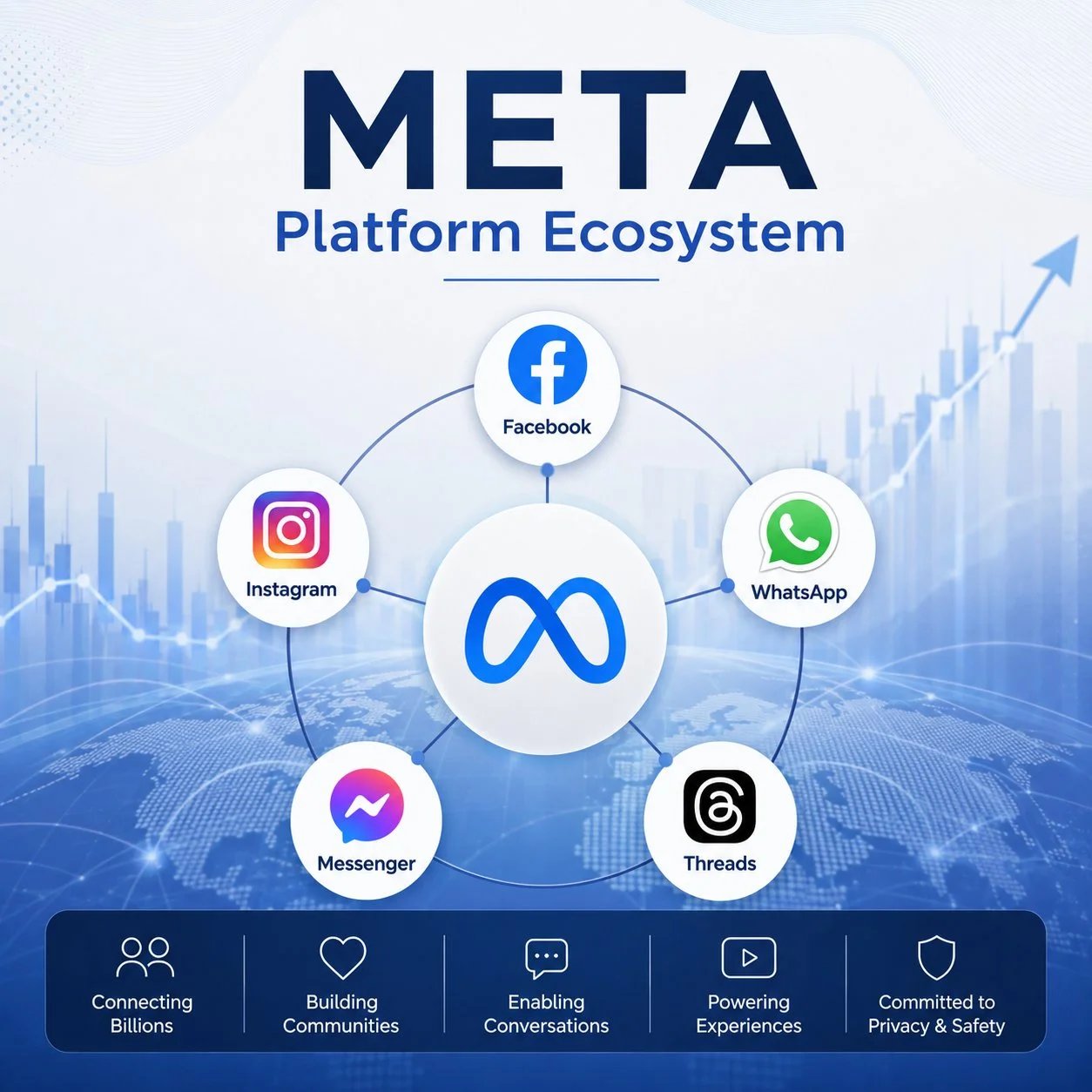
- Meta Platforms’ core advertising business continues to generate the overwhelming majority of revenue and cash flow, funding an aggressive AI infrastructure buildout.
- Capital expenditures have climbed sharply as Meta invests in data centers, GPUs, and custom silicon to support AI models and ranking systems.
- Investors are weighing whether ad revenue growth can keep pace with rising depreciation and operating costs tied to AI.
- Meta’s family-of-apps reach, including Facebook, Instagram, WhatsApp, and Threads, remains the foundation of its ad targeting and measurement advantage.
- The central debate: does AI spending produce a durable return, or does it compress margins before monetization scales?
The Ad Engine Remains The Cash Machine
Meta Platforms still derives the vast majority of its total revenue from advertising across its family of apps. That concentration is both the company’s greatest strength and the lens through which every AI investment must be judged. Facebook and Instagram together represent one of the largest and most sophisticated digital advertising systems ever built, and the company’s ranking and recommendation models are already AI-driven at their core. When Meta talks about AI, it is not describing a side project — it is describing the next generation of the machinery that decides which ad a user sees and how much an advertiser pays for that impression. The practical effect is that AI spending has a direct line of sight to the core business. Improvements in ranking, creative generation, and automated campaign tools can lift ad relevance and pricing power. That is the bull case in its simplest form: better models mean better monetization per user, and Meta has roughly three billion daily users to monetize.
The Cost Side Is Where The Tension Lives
The bear case centers on the income statement below the revenue line. Meta has guided to substantially elevated capital expenditures as it builds out AI data centers and procures advanced accelerators. Those costs eventually flow through as depreciation, which hits operating margins regardless of whether the corresponding AI products generate revenue in the same period. In addition, the company has been absorbing higher operating expenses tied to technical talent, infrastructure, and research. This creates a timing mismatch that markets dislike. Cash goes out today; the revenue return may arrive over several years, if it arrives at all. Meta has also been building custom silicon and expanding its own infrastructure to reduce long-run dependence on external suppliers, a strategy that lowers unit costs at scale but requires heavy upfront investment.
What Investors Should Watch
Three variables matter most. First, advertising revenue growth, particularly the pace of impression growth and average price per ad. Second, the trajectory of total costs and expenses, especially depreciation and the company’s forward capex guidance. Third, any disclosure about AI product monetization — subscription offerings, business messaging, or AI-assisted ad tools that carry incremental pricing. Meta’s balance sheet and cash generation give it unusual flexibility to fund this cycle without straining its financial position. That is a genuine advantage over smaller competitors. But scale does not eliminate the core question: the advertising engine is being asked to pay for an AI ambition whose payoff timeline remains unproven. For now, the market is effectively underwriting two things at once — a mature, highly profitable ad franchise and a capital-intensive AI bet layered on top of it. As long as ad revenue compounds, the spending looks like investment. If growth decelerates while costs keep climbing, the same spending starts to look like a margin problem. That is the fulcrum on which the Meta story currently rests.







Comments are closed.