
Market Sentiment Turns Cautious
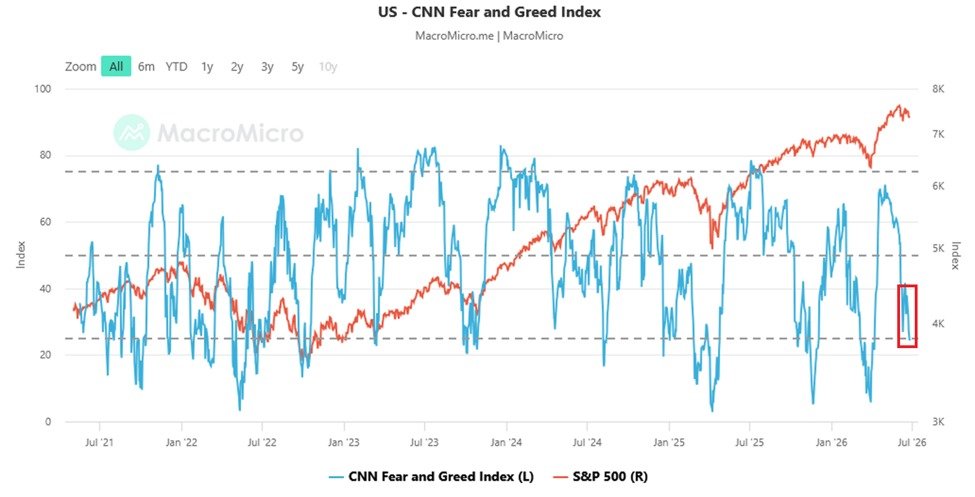
Recent data reveals a significant shift in investor sentiment as the Fear & Greed Index has plummeted to 24.8, marking the lowest level since early April. This decline signals a state of ‘Extreme Fear’ among investors, as the index dips below the critical 30-point threshold. The current reading contrasts sharply with the S&P 500, which is only 3.7% off its all-time high, indicating a disconnect between market performance and investor sentiment.
The Fear & Greed Index, a barometer of market psychology, reflects the emotional state of investors and can often signal potential market corrections. Historically, levels below 30 indicate heightened fear, which can lead to increased volatility and caution in trading strategies.
Comparative Analysis of Fear Levels
This latest reading comes in the wake of previous lows recorded earlier this year, with the index bottoming at 5.8 points on March 30 and 5.2 points in November 2024. Such extreme readings often precede significant market movements, either to the upside or downside. Investors are advised to monitor these fluctuations closely, as they can provide insights into potential market reversals.
Additionally, the current five-day average put-to-call ratio has risen to 0.84, the highest level since the second week of April. This metric suggests that investors are increasingly hedging against potential declines, further emphasizing the prevailing cautious sentiment. The elevated put-to-call ratio indicates that traders are buying more puts than calls, reflecting a bearish outlook on market direction.
Understanding the Implications
The implications of this shift in sentiment are significant for market participants. While the S&P 500 remains near its all-time highs, the growing fear among investors could lead to increased market volatility. Historically, periods of extreme fear have often been followed by market corrections, as investors may choose to liquidate positions to mitigate risk.
Moreover, the current environment suggests that while the market may appear resilient, underlying fears could trigger a reassessment of asset values. Investors should consider diversifying their portfolios and employing risk management strategies to navigate this uncertain landscape.
As we move forward, keeping a close watch on sentiment indicators like the Fear & Greed Index and the put-to-call ratio will be crucial for understanding market dynamics. These tools can help investors gauge when to enter or exit positions, especially in a climate characterized by fear and uncertainty.
Conclusion and Future Outlook
In summary, the recent drop in the Fear & Greed Index to 24.8 underscores the growing anxiety among investors, despite the S&P 500’s proximity to record highs. As market participants grapple with this dichotomy, the rising put-to-call ratio suggests a cautious approach is being adopted. Investors are advised to remain vigilant and prepared for potential shifts in market sentiment.
Looking ahead, the interplay between fear and market performance will be pivotal. Should the index continue to reflect extreme fear, it may serve as a precursor to a market correction, making it essential for investors to stay informed and adaptable in their strategies.










Comments are closed.